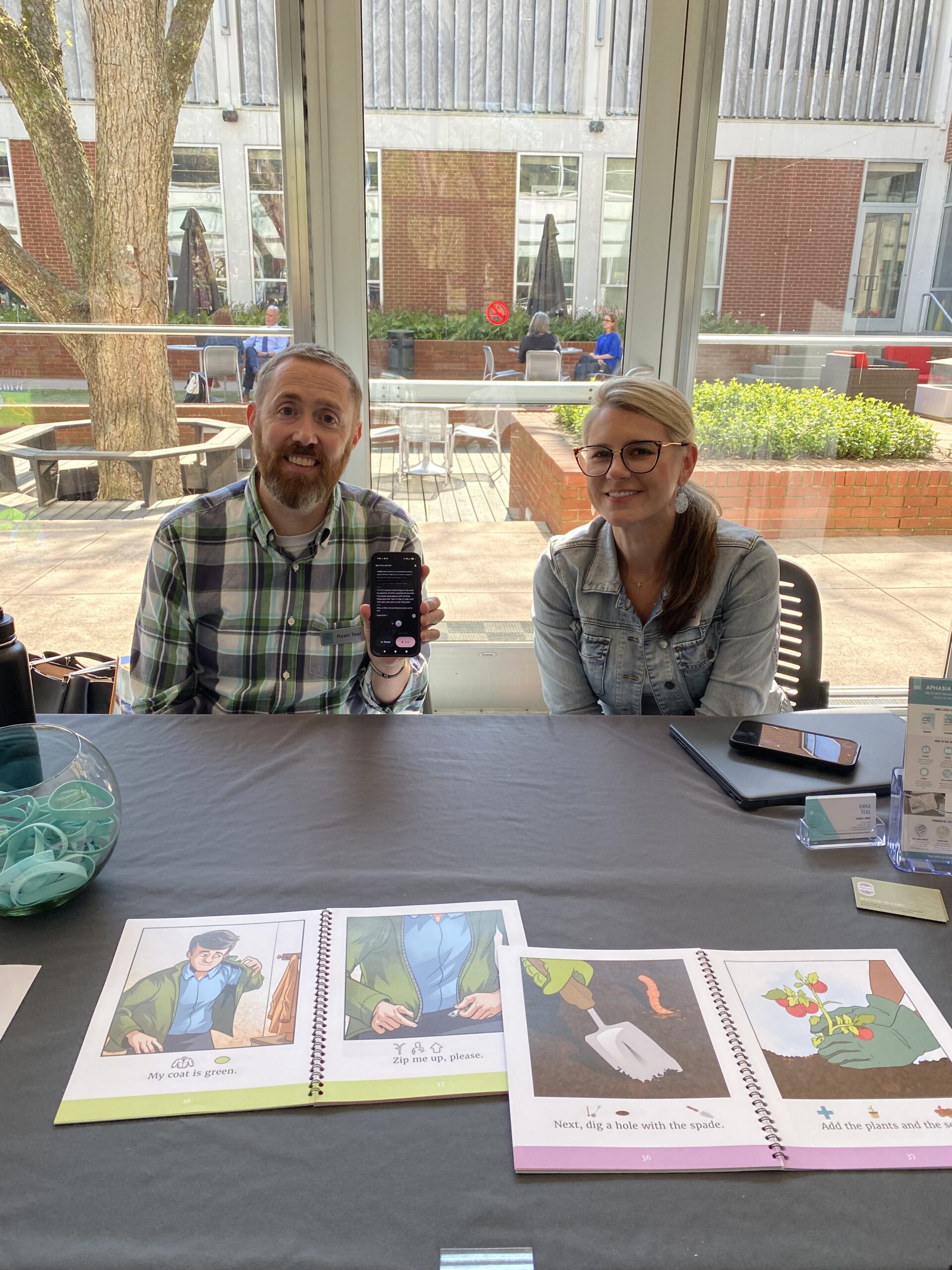
I could have taken a selfie, but I want the focus to be on Ryan’s story.
This past week, I attended the GSHA Conference at the University of Georgia, and next to my table was Ryan and his wife, Laura.
What I love about conferences is that sometimes you meet some of the most interesting and amazing people—and Ryan was that for me.
You see, Ryan had a stroke about eight years ago, resulting in aphasia. In addition, he also had some right-sided weakness with limited hand and arm mobility. I didn’t ask his age, but he appeared to be in his mid-to-late 30s.
We had many conversations.
What made them interesting was that Ryan used an app—Otter.ai (speech-to-text) on his phone—to support his language processing challenges. He would read what I said on his phone, then respond. His expressive language was limited, but he did great.
I shared how much I loved seeing him use speech-to-text, and he told me about other apps he uses, including Google Reader.
I loved seeing how technology was making a difference in his life.
Ryan was also a vendor at the conference, showcasing books for adults with aphasia that are more age-appropriate—something he wished he had after his stroke. Throughout my time there, I watched as Ryan interacted with different presenters as well as students around the conference.
He was living his life with a smile always and some support from his wife.
Technology helped Ryan function, connect, and engage.
Functional communication—that’s what it’s about.
As an SLP, I’m always fascinated by communication in action—especially outside the therapy room.
#SpeechLanguagePathology #SLP #AphasiaAwareness #CommunicationMatters #FunctionalCommunication #AssistiveTechnology #AAC